

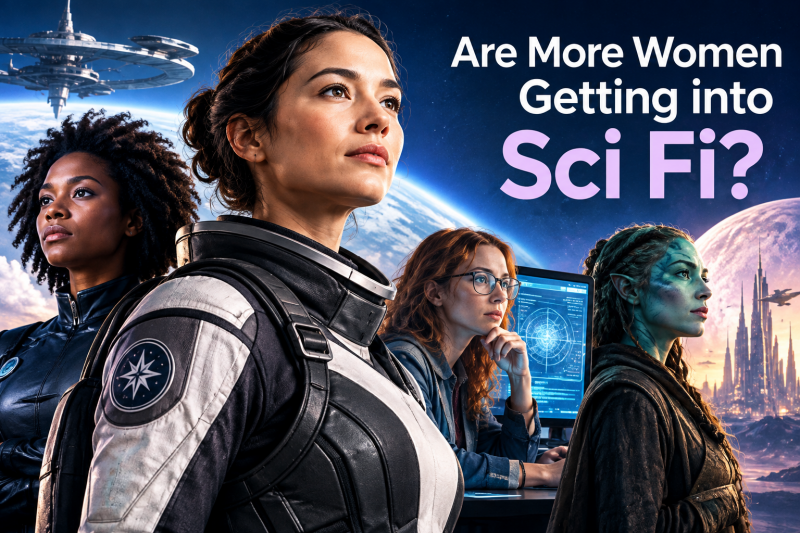
For much of its history, science fiction has often been described as a genre primarily created by men, written for men, and enjoyed by men. Walk into an old science-fiction convention, browse through the covers of classic science-fiction magazines, or look at photographs of early science-fiction clubs, and that impression can seem justified.
But was science fiction ever really a "man's genre"?
The answer is considerably more complicated.
Women have been involved with science fiction almost from the beginning. Mary Shelley wrote Frankenstein in 1818, a book that many consider one of the foundational works of modern science fiction. During the Golden Age of science fiction, women such as C. L. Moore, Leigh Brackett, and Catherine L. Moore were writing stories that appeared alongside those of their male counterparts. Later came writers such as Ursula K. Le Guin, Octavia E. Butler, Anne McCaffrey, Joanna Russ, and Margaret Atwood.
And yet, despite this long history, the perception that science fiction is primarily a male interest has persisted.
Today, however, something appears to be changing. Women are not merely participating in science fiction; they are increasingly visible as writers, directors, producers, scientists, artists, actors, editors, fans, podcasters, convention organizers, and creators of entire science-fiction worlds.
So the question is not simply, "Are more women getting into science fiction?"
Perhaps the more interesting question is:
Why are women becoming more visible in science fiction, and what does that mean for the future of the genre?
A Genre That Was Never Exclusively Male
Before discussing today's science-fiction audience, it is important to correct one misconception.
Women did not suddenly discover science fiction.
They have been there all along.
Mary Shelley's Frankenstein is an obvious starting point. Written by a young woman in the early nineteenth century, it explored artificial creation, scientific responsibility, human ambition, and the consequences of pushing beyond natural boundaries.
Shelley was asking questions that remain at the heart of science fiction today.
What happens when science gives humanity the ability to create life?
Should we do something simply because we can?
Who is responsible when an experiment goes wrong?
What does it mean to be human?
Those questions have not become less relevant in two centuries.
During the twentieth century, women continued making important contributions. C. L. Moore wrote influential stories during the pulp era. Leigh Brackett became an important science-fiction and fantasy writer and later worked in Hollywood. Andre Norton became one of the most prolific science-fiction and fantasy authors of the twentieth century.
Then came authors who fundamentally changed how science fiction could approach gender, society, politics, race, identity, sexuality, family, and human relationships.
Ursula K. Le Guin's The Left Hand of Darkness challenged conventional ideas about gender. Octavia E. Butler used science fiction to examine race, power, survival, social structures, and humanity's relationship with the "other." Anne McCaffrey demonstrated that science fiction could attract enormous audiences through stories combining science fiction, fantasy, adventure, relationships, and strong female characters.
These writers weren't exceptions to science fiction.
They were part of its development.
The Changing Face of the Science-Fiction Fan
If women have always been involved, why does science fiction sometimes still have a male-oriented reputation?
Part of the answer may be historical.
Early science-fiction magazines were marketed heavily toward young male readers. Their covers frequently emphasized spaceships, monsters, weapons, robots, alien worlds, and heroic male protagonists.
That imagery helped create an expectation about who science fiction was "for."
But science fiction has always been much broader than its covers suggested.
Science fiction can be about space exploration.
It can also be about marriage, family, politics, environmental collapse, artificial intelligence, aging, medical technology, loneliness, friendship, parenthood, economics, religion, or what happens when society changes faster than people can adapt.
And that broader definition has opened the door for audiences who might not have considered themselves science-fiction fans in the past.
Television has played an enormous role.
Programs such as Star Trek, The X-Files, Battlestar Galactica, Doctor Who, The Expanse, Black Mirror, and numerous other productions have demonstrated that science fiction doesn't have to be about technological gadgets and space battles.
It can be about people.
Women in Science Fiction Television
Consider some of the most recognizable female characters in science-fiction television.
Star Trek's Lieutenant Uhura was not merely a woman on a spaceship. She was an officer serving aboard one of the most important fictional vessels in television history.
Later, characters such as Captain Kathryn Janeway of Star Trek: Voyager demonstrated that a woman could occupy the central command position of a major science-fiction series.
Commander Michael Burnham became the central character of Star Trek: Discovery.
Other science-fiction programs have similarly placed women at the center of their stories.
Battlestar Galactica gave audiences President Laura Roslin and Starbuck, among many other complex female characters.
The Expanse featured characters such as Chrisjen Avasarala, Bobbie Draper, Naomi Nagata, and Drummer.
The importance of these characters goes beyond simply counting how many women appear on screen.
The question is what those women are allowed to do.
Are they merely romantic interests?
Are they supporting characters?
Or are they leaders, scientists, engineers, politicians, soldiers, explorers, strategists, villains, heroes, and ordinary people struggling to survive extraordinary circumstances?
Increasingly, the answer is all of the above.
Women Behind the Camera
The change is not limited to characters.
Women have increasingly taken important creative positions behind science-fiction productions.
Directors, producers, writers, visual-effects artists, costume designers, editors, cinematographers, composers, and production designers all contribute to the way a science-fiction universe is created.
This matters because the stories we see are influenced by the people who create them.
A broader range of creators can bring different experiences and questions into the storytelling process.
That doesn't mean women necessarily create "women's science fiction."
There is no single female perspective any more than there is a single male perspective.
Women are individuals.
One woman might want to write about artificial intelligence. Another might be fascinated by astronomy. Another might want to explore time travel. Another might want to write military science fiction. Another might be interested in horror, fantasy, robotics, environmental issues, or the philosophical question of what makes us human.
The important development is that women increasingly have the opportunity to tell those stories.
Science Fiction and the Rise of the Female Scientist
There is another important factor behind the growing female presence in science fiction: science itself.
For generations, many people imagined scientists as men working in laboratories.
That image has changed.
Women today work in virtually every scientific and technological field, including astronomy, physics, biology, medicine, engineering, computer science, planetary science, and space exploration.
As women become more visible in real-world science, it becomes increasingly natural to see women portrayed as scientists in science fiction.
Consider characters such as Dr. Beverly Crusher in Star Trek: The Next Generation, Dr. Jemma Simmons in Agents of S.H.I.E.L.D., or numerous scientists and engineers appearing throughout modern science fiction.
The relationship works both ways.
Science influences science fiction, and science fiction can influence how people imagine science.
A young girl watching a science-fiction program and seeing a woman serving as a scientist, engineer, captain, astronaut, or inventor may see a possibility that previous generations didn't see as clearly.
The Influence of Strong Female Characters
There is another reason women may be increasingly attracted to science fiction: modern science fiction provides female characters with greater freedom.
A woman doesn't necessarily have to fit into the traditional role of "the girlfriend," "the wife," or "the damsel in distress."
She can be the hero.
She can make mistakes.
She can save the world.
She can make morally complicated decisions.
She can be brilliant without being perfect.
She can be physically powerful without being reduced to a stereotype.
She can be vulnerable without being weak.
And perhaps most importantly, she can simply be a person.
Characters such as Ellen Ripley in Alien became important partly because audiences could see a woman confronting a terrifying situation and responding with courage, intelligence, determination, and resourcefulness.
Ripley wasn't created simply to be "a female version of a male hero."
She was a character.
That distinction is important.
Science Fiction Fandom Has Changed, Too
The science-fiction community itself has changed.
Conventions are no longer simply gatherings where fans trade paperback novels and discuss the latest rocket launch.
Modern conventions can include celebrity panels, cosplay, art, gaming, writing workshops, filmmaking, collectibles, podcasts, fan clubs, scientific presentations, and discussions about virtually every aspect of speculative culture.
Women participate in all of these activities.
Cosplay is a particularly visible example.
Women don't merely dress as female science-fiction characters. They may portray male characters, redesign existing characters, create original science-fiction costumes, or invent entirely new identities.
Online communities have expanded the possibilities even further.
A person no longer needs to live near a science-fiction club to participate in fandom.
Social media, YouTube, podcasts, Facebook groups, Reddit communities, Discord servers, and other online platforms have created opportunities for people to discuss science fiction with others around the world.
That has lowered one of the traditional barriers to participation.
Women Are Also Creating Science Fiction Communities
Perhaps one of the most interesting developments is that women aren't simply joining existing science-fiction communities.
They are creating their own.
Women are organizing conventions, podcasts, websites, book clubs, fan groups, writing communities, social-media channels, and online discussions devoted to science fiction.
They are also becoming increasingly visible as interviewers and commentators.
This matters because fandom isn't just about consuming stories.
It is also about discussing them.
Every time someone says, "Let's talk about this episode," or "What would happen if humanity discovered extraterrestrial life?" or "Does this technology make sense?" that person is contributing to the science-fiction conversation.
Science fiction thrives on conversation.
Is Science Fiction Becoming More Inclusive?
The answer appears to be yes, although that doesn't mean every part of science-fiction culture has changed at the same speed.
Some traditional corners of fandom remain heavily connected to the genre's older history.
Other communities are changing rapidly.
Modern science fiction is also increasingly diverse in terms of race, nationality, age, gender, culture, and experience.
This is important because science fiction is fundamentally about possibilities.
If science fiction imagines humanity living on Mars, traveling between stars, communicating with extraterrestrial civilizations, creating artificial intelligence, manipulating genetics, or traveling through time, then it makes sense that the people imagining those futures should come from many different backgrounds.
The future belongs to everyone.
Why shouldn't the people imagining it?
But Is This Really About Women "Getting Into" Science Fiction?
There is a danger in asking the question too narrowly.
If we say, "Women are finally getting into science fiction," we unintentionally suggest that women were previously outsiders.
History doesn't support that conclusion.
Women have been writing, reading, creating, and discussing science fiction for generations.
What has changed may be visibility.
The science-fiction community has become larger and more diverse, and the contributions of women are increasingly recognized.
The industry itself has also changed.
Publishing has changed.
Television has changed.
Movies have changed.
Streaming has changed.
Social media has changed.
And audiences have changed.
All of these developments have made it easier for people who may once have felt like outsiders to become active participants.
What Does the Future Hold?
If current trends continue, women will likely become an increasingly ordinary and expected part of every level of science-fiction culture.
We will see women writing novels.
Women directing films.
Women producing television programs.
Women designing spaceships for fictional universes.
Women creating visual effects.
Women writing comics.
Women appearing on science-fiction podcasts.
Women attending conventions.
Women discussing science and technology.
Women conducting actual scientific research that may inspire tomorrow's science fiction.
And women will continue creating characters that challenge our assumptions about what a hero, scientist, explorer, leader, or adventurer looks like.
But there is another possibility.
Perhaps eventually we will stop asking whether women are "getting into" science fiction.
Perhaps we will simply recognize that they are already there.
The Real Question
Science fiction has always asked us to imagine a future that is different from the present.
That is one of the reasons the genre remains so powerful.
It asks:
What if?
What if humanity reaches the stars?
What if machines become intelligent?
What if we discover another Earth?
What if time travel becomes possible?
What if we can genetically redesign ourselves?
What if humanity encounters another civilization?
But perhaps one of science fiction's most important questions is not technological at all.
It is:
Who gets to imagine the future?
For much of the genre's history, the answer appeared to be a relatively small group of people.
Today, that answer is becoming much larger.
Women are not simply entering science fiction.
They are helping define it.
They are writing its stories, creating its characters, producing its films and television programs, building its communities, attending its conventions, discussing its ideas, and imagining what humanity might become.
And that may ultimately be good for science fiction itself.
Because the more people who participate in imagining the future, the more possibilities we have to explore.
Science fiction was never supposed to be a prediction of one particular future.
It is a laboratory of ideas.
And laboratories work best when they contain different ideas, different experiences, and different questions.
So, are more women getting into science fiction?
Perhaps.
But an even better way to look at it is this:
More women are being recognized for the fact that they have been part of science fiction all along—and they are increasingly helping determine where the genre goes next.
And if science fiction is supposed to be about imagining the future, that is a future worth watching.