

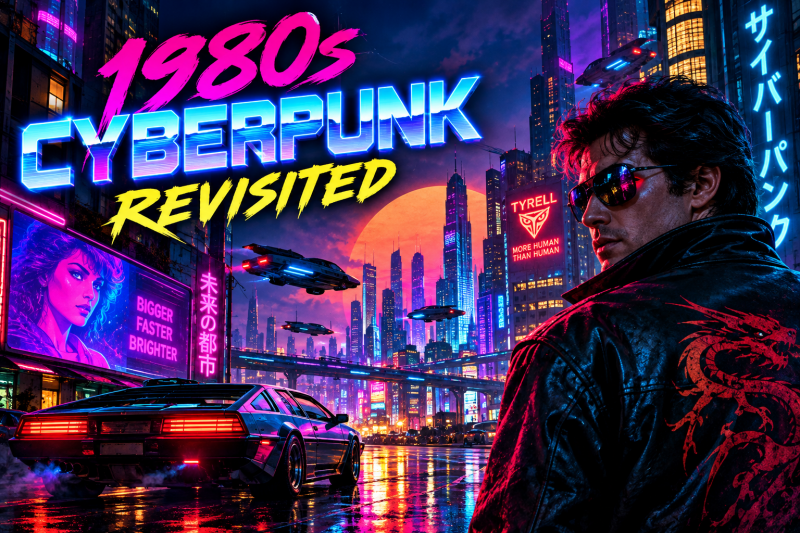
There was a time when the future looked dark. Not necessarily because humanity was doomed, but because the future imagined by a generation of science-fiction writers, filmmakers, artists, and game designers seemed increasingly dominated by giant corporations, computer networks, artificial intelligence, urban decay, neon lights, artificial bodies, and people struggling to maintain their humanity in a rapidly changing technological world.
That future became known as cyberpunk.
And while cyberpunk technically existed before the 1980s, it was during that decade that the movement exploded into popular culture.
Today, more than four decades later, it is worth looking back at 1980s cyberpunk and asking an intriguing question:
How much of that imagined future actually became our present?
The answer may surprise you.
What Exactly Was Cyberpunk?
Cyberpunk was never simply a story about computers.
At its heart, cyberpunk combined high technology with social disorder.
The classic formula was often described as "high tech, low life."
Computers were becoming incredibly powerful.
Corporations were becoming increasingly influential.
Information was becoming a form of power.
But ordinary people were not necessarily benefiting equally from technological progress.
The result was a future in which sophisticated technology existed alongside poverty, crime, political corruption, and social inequality.
That combination gave cyberpunk its distinctive personality.
Neon signs reflected in rain-soaked streets.
People wearing leather jackets and futuristic clothing.
Computer terminals glowing in dark apartments.
Hackers breaking into corporate systems.
Artificial limbs.
Virtual realities.
Megacorporations more powerful than governments.
And individuals trying to survive somewhere between the machine and the human world.
It was a very different vision of the future from the optimistic space-age visions of earlier science fiction.
William Gibson Changes Everything
No discussion of 1980s cyberpunk can begin anywhere except with William Gibson.
His 1984 novel Neuromancer became one of the defining works of the movement.
Gibson introduced readers to a future in which computer networks, artificial intelligence, multinational corporations, criminals, hackers, and human beings existed within a complex technological ecosystem.
The novel's famous opening immediately established the atmosphere that would become synonymous with cyberpunk.
But Gibson did something more important than inventing cool terminology.
He changed the way science fiction thought about computers.
The computer wasn't merely a machine sitting on a desk.
It was becoming a place.
A world.
A network.
A new environment in which human beings could exist.
Gibson called this virtual environment "cyberspace."
At the time, it seemed futuristic.
Today, we spend enormous portions of our lives inside digital spaces.
The Computer Revolution
The 1980s were the decade when computers began moving into ordinary homes and workplaces.
Personal computers were becoming increasingly common.
Video game systems were exploding in popularity.
Computer networks were beginning to expand.
And people were starting to realize that information itself could become enormously valuable.
Cyberpunk writers recognized the implications.
If computers connected everyone, then whoever controlled information could potentially control people.
That idea seems remarkably contemporary.
Today, companies know what we search for, what we buy, where we travel, what videos we watch, and what subjects interest us.
The technology is vastly more sophisticated than anything available in 1985.
But the underlying cyberpunk question remains:
Who controls the information?
Blade Runner
Then came one of the most influential science-fiction films ever made.
Ridley Scott's Blade Runner, released in 1982, presented a future Los Angeles that looked nothing like the clean, optimistic cities of traditional science fiction.
It was overcrowded, polluted, technologically advanced, culturally diverse, and dominated by enormous corporations.
The film introduced replicants—artificial humans who looked and behaved remarkably like people.
But the most important question wasn't whether replicants were intelligent.
It was whether they were human.
That question remains central to cyberpunk.
If we create artificial beings that can think, feel, remember, and perhaps love, what separates them from us?
More than forty years later, artificial intelligence has made that question more relevant than ever.
Akira and the Japanese Connection
Cyberpunk was never exclusively American.
Japan became one of its most important cultural centers.
Katsuhiro Otomo's manga Akira, which began in 1982, presented a terrifying vision of futuristic Tokyo dominated by political instability, youth rebellion, military experimentation, and uncontrolled technological power.
The 1988 animated film adaptation became an international landmark.
Akira demonstrated that cyberpunk could be visually spectacular while simultaneously dealing with political and philosophical themes.
Its futuristic Tokyo remains one of the most influential visions of a technological city ever created.
The influence can still be seen in modern films, video games, anime, fashion, and graphic design.
RoboCop
Paul Verhoeven's RoboCop arrived in 1987 and added another dimension to cyberpunk.
The film combined cybernetic technology with corporate power, privatization, violence, consumer culture, and political satire.
At first glance, RoboCop appears to be a cyborg action hero.
But underneath the action is a much darker question:
What happens when corporations begin treating human beings as products?
The film's fictional corporation, Omni Consumer Products, is interested in profit and control.
That theme became a central element of cyberpunk.
Technology itself isn't necessarily evil.
The danger comes from the people and institutions controlling it.
The Hacker Hero
Cyberpunk also created a new kind of protagonist.
Earlier science-fiction heroes were often astronauts, scientists, soldiers, explorers, or inventors.
Cyberpunk's hero might instead be a hacker.
Someone who lives outside the traditional power structure.
Someone who understands computers better than corporations do.
Someone who can enter systems that were supposed to be inaccessible.
This was revolutionary.
The hacker became the digital equivalent of the cowboy.
The frontier was no longer the American West.
It was cyberspace.
And the computer keyboard became the new six-shooter.
The Fashion of Cyberpunk
Cyberpunk wasn't just literature and film.
It became a visual style.
Black leather.
Combat boots.
Sunglasses.
Metallic accessories.
Body modifications.
Bright neon colors.
Industrial environments.
The aesthetic often suggested that people had begun modifying their own bodies and identities to survive in a technological world.
Today, elements of that style appear everywhere.
In fashion.
Music videos.
Advertising.
Video games.
Movies.
Concerts.
Even modern technology companies occasionally borrow cyberpunk imagery to make their products appear futuristic.
The irony is that cyberpunk fashion once represented a dystopian future.
Today, pieces of that aesthetic are simply fashionable.
Did Cyberpunk Predict the Internet?
This is perhaps the most interesting question.
Cyberpunk writers did not predict the internet perfectly.
The real internet is considerably messier and more decentralized than many fictional versions.
But they understood something fundamental.
They understood that computers would eventually become connected.
They understood that people would spend enormous amounts of time interacting through digital networks.
They understood that identity could exist online.
They understood that information could become power.
And they understood that corporations would eventually have enormous influence over digital life.
Those predictions were remarkably perceptive.
What About Artificial Intelligence?
Cyberpunk also predicted something else.
AI.
Artificial intelligence appeared throughout cyberpunk stories, often in the form of sophisticated computer systems or artificial personalities.
But cyberpunk generally approached AI with suspicion.
What happens when machines become smarter than their creators?
What happens when corporations control them?
What happens when humans become dependent upon them?
Those questions have moved from science fiction toward reality.
Today's AI is not the sentient machine depicted in Blade Runner.
But it is already capable of producing text, images, music, software, analysis, and conversation.
The technology is advancing rapidly.
And suddenly, cyberpunk's old questions don't seem quite so fictional.
The Body Becomes Technology
Another defining characteristic of cyberpunk is the merging of humans and machines.
Artificial eyes.
Artificial limbs.
Neural interfaces.
Implanted electronics.
Enhanced physical abilities.
In the 1980s, these ideas seemed futuristic.
Today, sophisticated prosthetic limbs exist.
Neural implants are being researched.
Brain-computer interfaces are becoming increasingly advanced.
Medical technology is already demonstrating that the boundary between human biology and machines is not as absolute as it once appeared.
We aren't living in a cyberpunk world.
But we are moving toward a world in which the human body can increasingly interact directly with technology.
Why Cyberpunk Still Matters
The greatest achievement of 1980s cyberpunk wasn't predicting specific gadgets.
It was predicting questions.
Who owns technology?
Who controls information?
What happens when corporations become more powerful?
What does privacy mean in a connected world?
Where does humanity end and technology begin?
Can artificial intelligence become a form of life?
What happens when people can modify their bodies?
And perhaps the most important question:
Does technological progress automatically mean human progress?
Cyberpunk's answer was usually no.
Technology can make life better.
It can also make existing problems worse.
A society with incredible computers can still be poor.
A civilization with artificial intelligence can still be unjust.
A world connected by communications technology can still be lonely.
And a technologically advanced society can still lose sight of what makes people human.
Looking Back From 2026
From today's perspective, some elements of 1980s cyberpunk seem almost quaint.
The computers were enormous.
The networks were primitive.
The graphics were crude.
The futuristic clothing looks dated.
The technology often seems laughably limited.
But the ideas remain remarkably fresh.
We now live with smartphones instead of cyberdecks.
We use social networks instead of fictional cyberspace.
We interact with AI instead of replicants.
We use digital currencies instead of some of cyberpunk's imagined financial systems.
And giant technology corporations possess enormous amounts of information about our lives.
The details changed.
The questions didn't.
The Future That Cyberpunk Warned Us About
Perhaps that is why 1980s cyberpunk continues to fascinate us.
It wasn't really predicting the future.
It was warning us about one possible future.
The writers and filmmakers of that era looked at rapidly advancing technology and asked what could happen if society failed to keep up with it.
Their worlds were often dark because they were deliberately uncomfortable.
They wanted readers and audiences to think.
Technology should serve humanity.
Humanity should not become merely another component in the machine.
Four decades later, that warning may be more relevant than ever.
We now carry computers in our pockets that are vastly more powerful than the machines imagined by 1980s science fiction.
We communicate instantly across the planet.
Artificial intelligence is becoming increasingly capable.
Robotics is advancing.
Virtual and augmented reality are developing.
Biotechnology is changing medicine.
And the line between our physical and digital lives grows thinner every year.
Perhaps the greatest irony of cyberpunk is that the future it imagined didn't arrive exactly as predicted.
Instead, pieces of it arrived separately.
A little bit of Neuromancer.
A little bit of Blade Runner.
A little bit of Akira.
A little bit of RoboCop.
And a great deal of technology that no 1980s writer could have imagined.
The cyberpunk future isn't here.
Not exactly.
But if we look around carefully, we might discover that we are already living in its early chapters.
And perhaps the most important lesson those 1980s visionaries left us is this:
The future isn't determined by technology. It is determined by what human beings choose to do with it.