

For centuries, invisibility has been a staple of science fiction—from magical cloaks to advanced alien technology. But could science ever make something truly invisible? Modern physics and materials science have already produced some remarkable ways to manipulate light. In this article, we’ll explore what science can actually do today, what remains theoretical, and whether true invisibility might someday become reality.
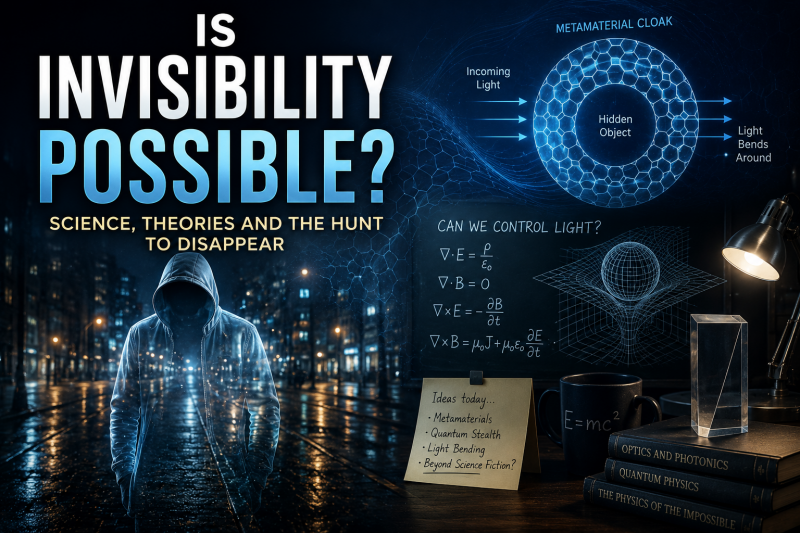
Is Invisibility Possible?
For generations, invisibility has been one of science fiction's favorite ideas.
Put on a mysterious cloak, activate a futuristic device, or step inside an experimental machine—and suddenly you're gone.
You can see everyone else.
They can't see you.
From H. G. Wells's The Invisible Man to modern superhero movies, television, and video games, invisibility has represented one of humanity's oldest fantasies:
The ability to be present without being seen.
But unlike faster-than-light travel or time machines, invisibility isn't entirely confined to science fiction.
Scientists have already demonstrated technologies that can hide objects from particular forms of detection.
The trick is understanding what "invisible" really means.
Can an object disappear completely?
Can light simply pass around it?
Can a person become invisible to the human eye?
Could a future soldier walk through a battlefield without being detected?
And could we someday create a real-life invisibility cloak?
The answer is fascinating.
Science says some forms of invisibility are possible—but the perfect invisibility of science fiction remains far beyond our current technology.
What Does "Invisible" Actually Mean?
Before discussing invisibility, we need to understand vision.
You see an object because light interacts with it.
Light strikes the object.
Some of that light is absorbed.
Some is reflected.
The reflected light enters your eyes.
Your brain processes the information and constructs an image.
Therefore, if you want to make an object invisible, you somehow have to prevent the observer from receiving the normal information that reveals the object's presence.
That sounds simple.
But it isn't.
The object still has to exist.
It still occupies space.
It still interacts with its environment.
And light isn't the only way we detect things.
We can detect objects through sound.
Heat.
Radar.
Magnetic fields.
Motion.
Pressure.
Even disturbances in the surrounding environment.
So true invisibility would require much more than simply making something optically transparent.
The Simplest Form: Transparency
The most obvious way to become invisible is to become transparent.
Glass provides a familiar example.
Light passes through it, allowing us to see what lies behind it.
But glass isn't actually invisible.
We can see its edges.
We can see reflections.
We can see distortions.
We can see it when it becomes dirty.
And if light passes through a material at an angle, the material can bend the light.
So transparency isn't the same thing as invisibility.
For a human being to become invisible, the body would need to interact with light in an extraordinarily controlled way.
And there is another enormous problem.
Your eyes need light to see.
If your eyes became perfectly transparent, they couldn't necessarily function normally.
The human body is not designed to disappear optically.
Bending Light
Now we reach one of the most exciting areas of modern physics.
What if you didn't make the object transparent?
What if you made the light go around it?
Imagine placing an object in the middle of a stream of water.
The water flows around the object and then comes back together.
Now imagine doing something similar with electromagnetic waves.
If light could be guided around an object and then restored to its original path, an observer might see what appears to be the background rather than the object.
That is the basic concept behind some forms of cloaking.
And scientists have demonstrated versions of it under controlled conditions.
Enter Metamaterials
One of the key technologies involved in modern cloaking research is something called a metamaterial.
Metamaterials are engineered structures designed to interact with electromagnetic waves in unusual ways.
Their behavior depends not simply on the chemical ingredients from which they're made, but on the carefully designed structure of those materials.
Scientists can manipulate how electromagnetic waves interact with these structures.
Under specific conditions, that can produce remarkable effects.
Some experiments have demonstrated cloaking-like behavior for particular wavelengths of electromagnetic radiation.
That is a long way from making a human being disappear.
But it proves something important: Controlling the path of electromagnetic waves is physically possible.
The Problem With Color
Suppose you built a cloak capable of bending visible light around an object.
You would still face another problem.
Visible light contains many wavelengths.
Red.
Orange.
Yellow.
Green.
Blue.
Violet.
A successful cloak would need to manipulate a broad range of wavelengths simultaneously.
That is extremely difficult.
A device might work very well for one wavelength and poorly for another.
The result would be a strange-looking object rather than a perfectly invisible one.
Modern cloaking systems therefore tend to work under specific conditions.
Science fiction usually ignores those limitations.
Reality doesn't.
What About the Human Body?
Now imagine attempting to make a person invisible.
The problem becomes much more complicated.
The human body is not a simple object.
It contains bones.
Muscles.
Blood.
Organs.
Skin.
Hair.
Air-filled cavities.
Each interacts with light differently.
A cloak would somehow have to control the path of incoming and outgoing light around this extraordinarily complicated structure.
And it would have to work while the person moved.
Imagine walking while wearing your invisibility cloak.
Every movement changes the geometry.
The cloak would have to adapt continuously.
That is an enormous engineering challenge.
The Shadow Problem
There's another issue science fiction often overlooks.
Suppose you're invisible but standing in sunlight.
What happens to your shadow?
If light is bending around you, your shadow might also behave strangely.
If the cloak simply makes you transparent, the background might show through you.
But if you're actually blocking light, an observer could potentially detect the missing illumination.
True invisibility therefore requires controlling not only what light comes toward the observer, but what happens to the entire surrounding light field.
That's considerably harder than simply hiding the object.
Heat Gives You Away
Even if we somehow solved visible-light invisibility, humans produce heat.
Your body is warmer than its surroundings.
That means you emit infrared radiation.
A person might be invisible to the human eye while remaining extremely obvious to an infrared camera.
This is an important distinction.
Something can be invisible in one part of the electromagnetic spectrum and highly visible in another.
Military technology already exploits multiple forms of detection.
Radar can detect objects that humans can't see.
Thermal cameras can detect heat.
Night-vision equipment can amplify low levels of light.
So a future invisibility cloak designed only for visible light wouldn't necessarily make someone undetectable.
Sound Is Another Problem
Now imagine that you have somehow become optically invisible.
You walk into a room.
People can't see you.
Then you say something.
They hear your voice.
You're no longer invisible in any practical sense.
Even without speaking, your footsteps could reveal your location.
Your movement could disturb air.
Objects you touch could move.
A chair could suddenly appear to move by itself.
A door could open without anyone visible.
Invisibility therefore isn't merely an optical problem.
It is an information problem.
You must prevent observers from detecting evidence that you're there.
Radar and Other Sensors
Modern technology makes the challenge even greater.
A person might be invisible to the eye but detectable by radar.
Or invisible to radar but visible through thermal imaging.
Or hidden from both but detected through sound.
Or concealed visually but revealed by pressure sensors.
The more advanced our detection systems become, the harder true invisibility becomes.
In a world filled with cameras and sensors, simply disappearing from human vision wouldn't necessarily make you undetectable.
Could Active Camouflage Work?
There is another possibility.
Instead of bending light around you, imagine covering yourself with a system that displays the background behind you.
In principle, cameras on one side could capture the environment.
Screens or other optical systems could reproduce that information on the opposite side.
The observer would see something resembling the background.
This concept is sometimes called active camouflage.
It wouldn't make the object truly invisible.
But under certain circumstances, it could make it much harder to see.
The problem is perspective.
A person standing on your left sees a different background than someone standing on your right.
Someone above you sees something different again.
A practical system would therefore have to account for multiple viewing angles simultaneously.
That is extremely difficult.
What About Harry Potter's Cloak?
The famous invisibility cloak from Harry Potter is almost the perfect fictional version.
Put it over yourself and you disappear.
It doesn't matter where observers stand.
It doesn't matter what the lighting conditions are.
It doesn't matter whether you're walking or standing.
That is the fantasy.
A real cloak would probably come with a much longer instruction manual:
Works only at selected wavelengths.
Limited viewing angles.
Requires external power.
Does not conceal heat.
Does not conceal sound.
Performance decreases with movement.
Do not use in direct sunlight.
Reality is considerably less magical.
Could Quantum Physics Help?
Whenever scientists encounter an apparently impossible problem, quantum physics eventually enters the conversation.
Quantum mechanics does allow matter and light to behave in ways that seem extremely strange.
But there is no known quantum technology that can simply make a human being disappear from observation.
Quantum effects are real.
They are also frequently misunderstood.
Quantum mechanics isn't a magical loophole that allows anything imagined by science fiction.
For now, there is no known quantum "invisibility button."
Could We Make Objects Invisible to Radar?
This is much more realistic.
Scientists and engineers have been developing ways of reducing radar signatures for decades.
Certain aircraft are designed so that radar waves are reflected away from the source rather than directly back toward it.
Special materials can also absorb some electromagnetic energy.
This doesn't make the aircraft invisible.
It makes it harder to detect.
That distinction is important.
Much of what we call "stealth" technology is really a form of engineered detectability reduction.
The same basic philosophy could eventually apply to other wavelengths.
The Future: Invisibility May Become "Selective"
The most realistic future isn't a person becoming invisible to everything.
It is a person becoming difficult to detect by a particular sensor.
Imagine clothing that reduces infrared visibility.
Materials that reduce radar reflection.
Optical camouflage that makes a person harder to see from certain directions.
Adaptive surfaces that change appearance depending on the environment.
Individually, these technologies could be useful.
Combined, they might produce something that looks remarkably like science-fiction camouflage.
But it still wouldn't be perfect invisibility.
Medical Invisibility?
There is an even stranger possibility.
Researchers are studying materials and biological techniques that manipulate how light interacts with tissue.
In the distant future, perhaps optical technologies could be used to make certain tissues more transparent for medical imaging.
That wouldn't make a person invisible.
But it demonstrates how the principles behind invisibility could have practical applications beyond espionage or military technology.
Science frequently takes ideas that sound like science fiction and finds unexpected uses for them.
Would Invisibility Be Dangerous?
Absolutely.
Imagine an individual who could become genuinely undetectable.
Privacy would become almost meaningless.
Security systems would be challenged.
Criminal investigations could become extraordinarily difficult.
Military operations could change dramatically.
And everyday social behavior could be transformed.
Who would have the right to use such technology?
Would governments regulate it?
Would private citizens be allowed to own it?
Could an invisible person be detected by emergency services?
Technology has a habit of creating legal and ethical questions long before society is prepared to answer them.
The More Important Question
Perhaps the real question isn't: "Can we become invisible?"
It's: "Can we control what information about ourselves is visible to others?"
In some ways, we're already approaching that problem.
Digital privacy is a form of invisibility.
Encryption hides information.
Anonymous communications hide identities.
Privacy technology attempts to prevent unwanted observation.
Physical invisibility may therefore be only one extreme example of a much larger technological goal: controlling who can detect you, what they can detect, and how much they can know.
So, Is Invisibility Possible?
If by invisibility we mean: "Can a human being completely disappear from every possible form of detection?"
Today's answer is no.
There is no demonstrated technology capable of doing that.
But if we ask: "Can science manipulate light and other electromagnetic waves in ways that make objects harder to detect?"
The answer is yes.
And that's what makes the subject so fascinating.
Scientists have already demonstrated limited cloaking effects.
Metamaterials can manipulate electromagnetic waves.
Stealth technology can reduce radar signatures.
Adaptive camouflage can alter the appearance of objects.
Optical systems can redirect or manipulate light.
None of these technologies produces the perfect invisibility of science fiction.
But they represent steps toward something surprisingly similar.
The Future of Disappearing
Perhaps someday a person will wear clothing capable of adapting its appearance to the surrounding environment.
Perhaps vehicles will become extremely difficult to detect by particular sensors.
Perhaps optical systems will bend or redirect light around small objects.
Perhaps technologies we haven't imagined yet will make today's experiments look primitive.
But the perfect invisible man remains a much greater challenge.
To achieve true invisibility, science would have to control an enormous amount of information—not only visible light, but infrared radiation, sound, electromagnetic signals, heat, shadows, and the physical disturbances created by movement.
That is an extraordinary requirement.
And yet, this is exactly why science fiction continues to fascinate us.
It takes a seemingly impossible idea and asks: "What would it take to make it real?"
Maybe we will never have Harry Potter's cloak.
Maybe H. G. Wells's invisible man will remain permanently fictional.
But the history of science teaches us something important.
The boundary between impossible and merely difficult has a habit of moving.
And somewhere in a laboratory today, a scientist may be manipulating light in a way that would have seemed like magic to Wells.
The invisible future may not arrive as dramatically as science fiction predicted.
It may come quietly.
One wavelength at a time.
One material at a time.
One experiment at a time.
Until someday we look back and realize that humanity didn't make itself completely invisible.
We simply learned how to become much harder to see.