

While humankind reaches for the stars he must first learn to take "baby steps". NASA is making such arrangements now in preparation for those future goals.
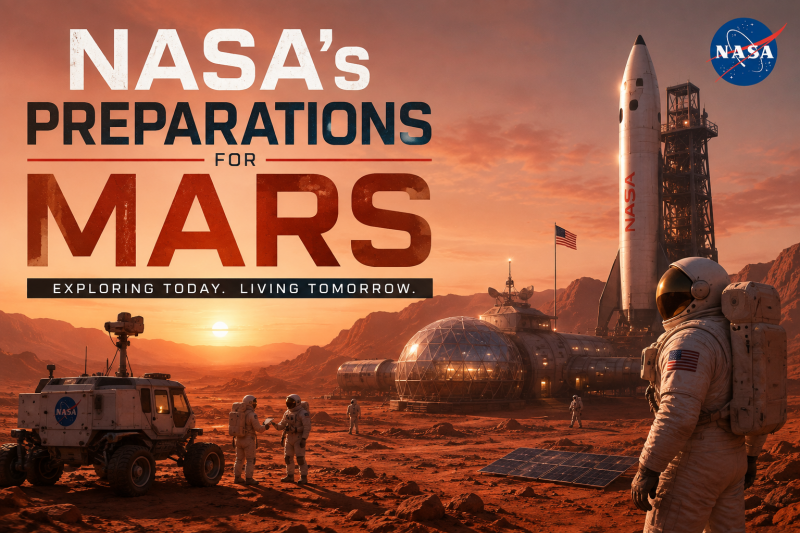
NASA’s Preparations for Mars
For more than half a century, Mars has occupied a special place in the human imagination. It has been the destination of science-fiction writers, the subject of countless films and television programs, and the focus of increasingly sophisticated robotic exploration. Today, however, the idea of sending humans to Mars is moving beyond fiction. NASA is developing the technologies, operational experience, and human knowledge that could eventually make a crewed expedition to the Red Planet possible.
The important point is that NASA is not preparing for Mars with a single spacecraft or a single mission. Instead, the agency is building a broad Moon-to-Mars architecture—a step-by-step strategy in which the Moon becomes a proving ground for technologies and procedures that will eventually be needed much farther from Earth. NASA describes the architecture as a framework for long-term human exploration of the Moon, Mars, and eventually destinations beyond.
The Moon Is the Training Ground
Before astronauts travel approximately 140 million miles to Mars, NASA wants them to gain experience operating far from Earth.
That is one of the fundamental purposes of the Artemis program. NASA's current Moon-to-Mars architecture divides the effort into four broad segments: Human Lunar Return, Foundational Exploration, Sustained Lunar Evolution, and Humans to Mars. The early stages are intended to demonstrate transportation, communications, habitation, mobility, power, logistics, and other capabilities that can later be adapted for Mars.
The Moon is particularly valuable because it is close enough to Earth that problems can potentially be addressed more quickly than they could on Mars. A spacecraft malfunction on the Moon is serious; the same malfunction 150 million miles from Earth could become fatal.
NASA therefore intends to learn how astronauts live and work for extended periods away from Earth, how equipment performs in an alien environment, and how crews respond when they cannot depend upon immediate assistance from mission control.
Mars will demand a completely different level of independence.
The Human Factor
Perhaps NASA's greatest challenge isn't building a rocket. It is keeping human beings alive, healthy, productive, and psychologically stable for an expedition that will last years.
A Mars crew will face isolation, confinement, radiation, reduced gravity, limited resources, communication delays, and the constant possibility of equipment failure. Unlike astronauts aboard the International Space Station, Mars explorers cannot expect a resupply spacecraft every few months—or an emergency trip home.
NASA is addressing these problems through its Crew Health and Performance Exploration Analog, known as CHAPEA. At Johnson Space Center in Houston, volunteers live inside a 1,700-square-foot, 3D-printed habitat designed to simulate important aspects of life on Mars. The habitat includes living quarters, work areas, a medical station, exercise facilities, a kitchen, and facilities for growing crops.
The second CHAPEA crew entered the habitat on October 19, 2025, for a simulated 378-day Mars mission. As of May 2026, the crew had passed the 200-day mark. The simulation includes limited resources, simulated Mars-walks, equipment problems, crop cultivation, and periods in which communications with Earth are deliberately restricted.
That last factor is especially important. Communications between Earth and Mars can involve delays of many minutes in each direction. Astronauts cannot simply call Houston and wait for an engineer to talk them through every problem. Eventually, the crew must be capable of making critical decisions independently.
CHAPEA is therefore more than an experiment in living inside a small building. It is an experiment in whether human beings can function as an effective team when Earth is no longer immediately available.
Learning to Live Off the Land
One of the biggest lessons NASA has already learned is that future Mars explorers cannot afford to bring everything they will need from Earth.
Every pound launched toward Mars requires enormous amounts of energy and transportation capability. Food, water, oxygen, fuel, construction materials, and other supplies would add up rapidly.
NASA's answer is in-situ resource utilization, or ISRU—the idea of using resources found on Mars itself.
A spectacular demonstration came from NASA's Perseverance rover. Its Mars Oxygen In-Situ Resource Utilization Experiment, better known as MOXIE, extracted oxygen from the Martian atmosphere. During 16 operating runs, MOXIE produced 122 grams of oxygen and reached a production rate of 12 grams per hour at 98 percent purity or better. (NASA Jet Propulsion Laboratory)
That may sound insignificant compared with what a human mission would require. It was never intended to supply an astronaut crew. Its purpose was to prove that the basic concept works.
The implications are enormous.
Mars' atmosphere is composed mostly of carbon dioxide. A much larger descendant of MOXIE could potentially manufacture oxygen for astronauts to breathe and, more importantly, oxygen that could be used as rocket oxidizer. Producing return-trip propellant on Mars could eliminate the need to launch enormous quantities of it from Earth. (NASA Science)
In other words, the technology could eventually allow astronauts to use Mars itself as part of their transportation system.
The Problem of Radiation
Another major obstacle is invisible.
Earth's atmosphere and magnetic field provide substantial protection from cosmic radiation. Astronauts traveling to Mars would spend many months outside that protection and then live on a planet with a much thinner atmosphere.
NASA therefore must develop better radiation protection for both spacecraft and surface habitats.
Recent research involving the Artemis I mission illustrates the importance of this work. A radiation-protection vest tested aboard the uncrewed Orion spacecraft demonstrated substantial reductions in radiation exposure during simulated extreme solar storms. Such technology is being studied as one possible component of protecting astronauts during future deep-space missions. (AP News)
But radiation protection will not be solved by a vest alone. Spacecraft and habitats may also need carefully designed shielding, potentially using materials already available to astronauts.
Transportation: Getting There and Getting Home
Then there is perhaps the most obvious problem: transportation.
A Mars mission requires far more than getting astronauts away from Earth. NASA must provide transportation from Earth, survival systems for the journey, a way to land substantial equipment on Mars, a surface habitat, power, mobility, communications, supplies, and ultimately a way for the crew to return.
That is why NASA's Moon-to-Mars approach emphasizes multiple interconnected transportation and infrastructure systems rather than one magical "Mars ship." NASA's architecture specifically identifies transportation, habitation, mobility, power, logistics, communications, and resource utilization as capabilities that must work together. (NASA)
Propulsion is also an area of continuing development. NASA and its partners are studying technologies that could eventually shorten the time astronauts spend in deep space. Faster transportation would reduce exposure to radiation, microgravity, isolation, and other hazards.
But speed alone isn't enough. The spacecraft must also be extraordinarily reliable.
A Mars mission has no roadside mechanic and no convenient emergency landing site.
Robots Go First
Long before astronauts establish a presence on Mars, robotic explorers will continue doing much of the groundwork.
NASA's robotic missions provide scientists with information about geology, climate, water, potential resources, and the hazards of different landing sites. Rovers such as Perseverance are effectively scouts for the eventual human explorers.
They also demonstrate technologies that may eventually become part of human missions.
This robotic-human partnership is likely to become increasingly important. Robots could arrive before astronauts, prepare landing areas, deploy equipment, investigate terrain, establish power systems, and potentially begin producing resources.
By the time humans arrive, Mars may no longer be an untouched destination. It could already contain the beginnings of an infrastructure designed specifically to support them.
Mars Is Becoming an Engineering Problem
Perhaps the most fascinating change is how NASA's approach to Mars has evolved.
For decades, "humans on Mars" was primarily a vision. Today it is increasingly an engineering problem.
NASA is asking practical questions: How much radiation can astronauts tolerate? How much food must be carried? How can oxygen be produced? How much water can be recycled? How can astronauts exercise in reduced gravity? How should habitats be constructed? How will crews respond to emergencies? What happens when communications are unavailable? How much equipment must be redundant?
None of these questions is simple.
But NASA does not have to answer them all at once.
The Moon provides a nearby laboratory. Robotic spacecraft provide scouts and technology demonstrations. CHAPEA provides a laboratory for the human element. Artemis provides experience in deep-space operations. Experiments such as MOXIE demonstrate how Mars itself might provide essential resources.
Piece by piece, the puzzle is being assembled.
The First Footprints
There is still no guarantee of exactly when humans will walk on Mars. The schedule, hardware, budgets, technologies, and priorities will continue to evolve.
But the direction is clear.
NASA's current strategy is not to leap directly from Earth to Mars. It is to build capability progressively—return to the Moon, learn to operate there for longer periods, develop technologies that reduce dependence on Earth, and use that experience to prepare for the far greater challenge of the Red Planet. NASA explicitly identifies Artemis as a key step toward its human Mars objectives. (NASA)
When the first astronauts eventually stand on Mars, their achievement will therefore represent much more than a single launch.
It will be the culmination of decades of robotic exploration, engineering experiments, human research, lunar missions, technological failures and successes, and countless decisions made by scientists and engineers who understood that Mars could not be reached safely by simply pointing a rocket at it.
The first humans on Mars will arrive carrying something far more valuable than a flag.
They will carry the accumulated knowledge of Earth.
And for the first time in human history, that knowledge may be enough to allow people to step onto another planet—and stay there.