

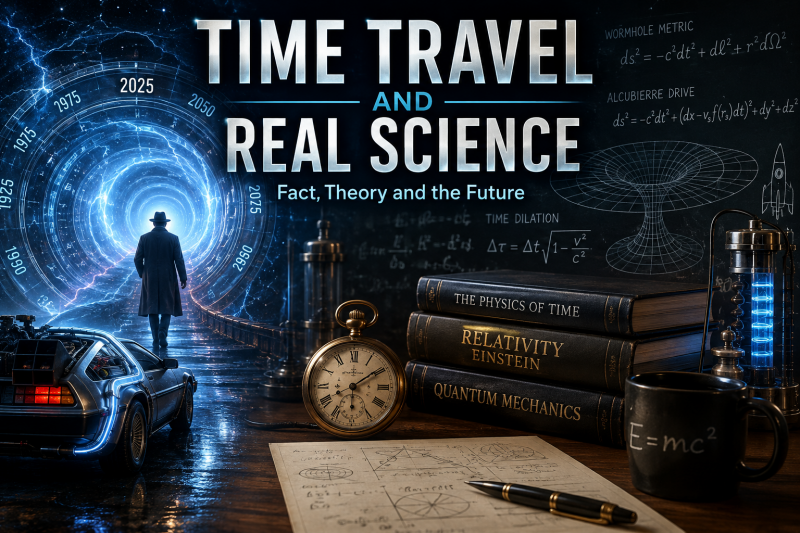
Time travel has been one of science fiction's most enduring ideas.
From H. G. Wells's The Time Machine to Back to the Future, Doctor Who, Star Trek, and countless other stories, writers have imagined human beings traveling through history and witnessing events that happened centuries ago—or jumping forward into a future that has yet to exist.
It sounds like pure fantasy.
But there is a surprising truth hidden inside the idea of time travel:
According to modern physics, traveling through time is not entirely impossible.
The catch is that real science looks very different from Hollywood.
We already know that time does not pass at exactly the same rate for everyone. Einstein's theories of relativity demonstrated that time is connected to motion, gravity, and the structure of space itself.
So could science eventually allow us to travel through time?
The answer depends on which direction we want to go.
We Are Already Traveling Through Time
In one sense, every human being is already a time traveler.
We are moving continuously from the past into the future at a rate of one second per second.
But Einstein showed that this simple statement becomes much more interesting when objects move at extremely high speeds or experience very strong gravitational fields.
This phenomenon is called time dilation.
According to Einstein's theory of special relativity, a clock moving at extremely high speed relative to another clock will measure less elapsed time.
The effect is tiny at everyday speeds.
A person traveling in a car is not going to return home noticeably younger than someone who stayed behind.
But as an object approaches the speed of light, the difference becomes increasingly significant.
If a spacecraft could travel close enough to the speed of light, its passengers could potentially experience a few years while considerably more time passed for people remaining on Earth.
The astronauts would not feel as though they were traveling into the future.
Their clocks and bodies would seem perfectly normal.
But when they returned to Earth, they could discover that much more time had passed here than they experienced during their journey.
In a very real scientific sense, they would have traveled into Earth's future.
Astronauts Have Already Experienced It
This isn't merely theoretical.
Astronauts have experienced tiny amounts of time dilation.
Because astronauts aboard spacecraft move at high velocities relative to people on Earth—and because they experience slightly different gravitational conditions—their elapsed time differs by a small amount from that of people on the ground.
The effect is extremely small for current human spaceflight, but it can be measured with highly accurate clocks.
Even the Global Positioning System depends upon Einstein's theories.
GPS satellites experience both special-relativistic and gravitational time differences compared with clocks on Earth's surface. Engineers must account for those differences or GPS positioning would quickly become inaccurate.
So one of the strangest facts about modern technology is this:
Relativity is not merely an exotic theory. Your smartphone depends on physics that includes relativistic time corrections.
The Speed of Light
If humanity wants to travel dramatically into the future, one possibility would be traveling extremely fast.
But there is a fundamental obstacle.
The speed of light is approximately 186,000 miles per second, or about 300,000 kilometers per second.
According to special relativity, an object with mass cannot be accelerated to the speed of light.
The closer it gets, the more energy is required.
Reaching the speed of light would require an effectively infinite amount of energy.
That means the classic science-fiction spacecraft that simply accelerates to the speed of light is not compatible with our current understanding of physics.
But traveling at a fraction of the speed of light is another matter.
A spacecraft traveling at 99 percent of light speed would experience dramatic time dilation.
For the people aboard the spacecraft, the journey could be considerably shorter than it would appear to observers on Earth.
The travelers could return to a future Earth.
They could not return to yesterday.
And that distinction is extremely important.
Traveling Into the Past
Going backward in time is where the situation becomes much more difficult.
Physics contains mathematical possibilities that appear to permit unusual forms of time travel.
One of the most famous concepts involves wormholes.
A wormhole is a hypothetical tunnel connecting two distant regions of spacetime.
Imagine taking a sheet of paper and marking two points far apart. Normally, traveling from one point to the other means crossing the distance between them.
But if you fold the paper so that the two points touch, a shortcut becomes possible.
A wormhole would be somewhat analogous to that shortcut—but through the geometry of spacetime.
If wormholes exist, and if they could somehow be manipulated, they might theoretically connect not only different locations but different points in time.
There is one enormous problem.
We have never observed a traversable wormhole.
And even if nature permits them, we do not know how to create, stabilize, or safely travel through one.
The Exotic Matter Problem
Theoretical wormholes introduce another fascinating concept: exotic matter.
Some models suggest that maintaining an open, traversable wormhole could require forms of matter or energy with unusual properties, including negative energy density.
Physics does allow certain quantum phenomena involving negative energy effects under specialized circumstances.
But that is very different from possessing a giant supply of exotic material that could be used to construct a time machine.
At present, we have no demonstrated technology capable of doing anything remotely resembling that.
So while the mathematics can be fascinating, there is an enormous gap between a mathematical possibility and an engineering possibility.
The Grandfather Paradox
Suppose, however, that someone actually developed a machine capable of traveling into the past.
Immediately we encounter one of science fiction's most famous problems.
The grandfather paradox asks what would happen if a time traveler went into the past and prevented their own grandfather from having children.
If the grandfather never had a child, the time traveler would never have been born.
But if the time traveler was never born, how could they have traveled into the past and prevented their grandfather from having children?
The logical contradiction has fascinated physicists and philosophers for decades.
There are several proposed solutions.
One possibility is that backward time travel is simply impossible.
Another is that the universe somehow prevents paradoxical events.
Yet another possibility involves interpretations in which changing the past creates or enters a different branch of reality rather than altering the traveler's own history.
These ideas remain speculative.
We do not know which, if any, is correct.
Could the Past Be Changed?
Even without the grandfather paradox, changing history raises enormous problems.
Imagine traveling to 1920 and accidentally dropping a modern object on the street.
Perhaps someone finds it.
Perhaps they study it.
Perhaps it changes the development of technology.
That altered technology changes economics, politics, warfare, and culture.
A seemingly insignificant event could produce enormous consequences over generations.
This concept is sometimes called the butterfly effect.
The idea is that tiny changes can eventually produce enormous differences.
For a time traveler, history could be extraordinarily fragile.
Maybe the Universe Protects Itself
Some physicists have proposed ideas suggesting that the laws of physics might prevent situations in which time travel creates contradictions.
One famous concept is the chronology protection conjecture, associated with physicist Stephen Hawking.
The basic idea is that nature may somehow prevent the formation of conditions that would allow violations of causality.
We do not currently have experimental proof that this is true.
But it illustrates an important principle of modern physics:
The universe may contain rules that prevent certain apparently possible situations from actually occurring.
What About Time Machines?
Could someone eventually build one?
Based on current science, there is no known engineering method for constructing a machine that would allow a person to travel backward in time.
There are theoretical ideas involving wormholes, rotating black holes, cosmic strings, and unusual spacetime geometries.
But none has been demonstrated as a practical time machine.
The energy requirements alone could be enormous.
And some proposals may require conditions that cannot exist in the real universe.
That doesn't mean scientists have proven backward time travel impossible.
It means something more scientifically honest:
We don't know.
Science occasionally turns apparently impossible ideas into reality. Airplanes, spaceflight, nuclear energy, and global communications would have seemed absurd to people living centuries ago.
But science also teaches us that some ideas remain impossible because they conflict with fundamental laws of nature.
Time travel could ultimately fall into either category.
Black Holes and the Nature of Time
Black holes make the subject even stranger.
Near a black hole, gravity becomes extraordinarily strong, producing significant effects on the passage of time.
To a distant observer, a clock near the event horizon appears to run increasingly slowly.
For someone falling toward the black hole, however, their own clock would appear normal.
Again, time itself depends upon the observer's circumstances.
This is one of the reasons modern physics has transformed our understanding of time.
Time is not necessarily a universal cosmic clock ticking identically everywhere.
It is woven into spacetime.
And spacetime can be distorted.
The Most Realistic Time Machine
So what is the most realistic time machine humanity could build?
Surprisingly, it may already exist.
A sufficiently advanced spacecraft traveling at a substantial fraction of the speed of light could carry humans into Earth's future.
The travelers might experience years while decades—or perhaps much longer periods—passed for people who remained behind.
No wormhole would be necessary.
No paradox would be created.
No laws of physics would necessarily be violated.
The technology required, however, would be extraordinarily difficult.
We would need propulsion systems capable of accelerating a massive spacecraft to incredible speeds, enormous amounts of energy, protection from high-energy particles and radiation, and a way to slow down safely.
But unlike a machine that travels into the past, this type of future travel is firmly rooted in established physics.
The Ultimate Mystery
Perhaps the most fascinating aspect of time travel is that it forces us to reconsider what time actually is.
We experience time as something that moves from yesterday through today toward tomorrow.
But modern physics presents a much stranger picture.
Time can pass at different rates.
Gravity can affect it.
Motion can affect it.
Space and time are interconnected.
And under extreme conditions, the distinction between space and time becomes far less intuitive than our everyday experience suggests.
We may never build a machine capable of sending a person into the past.
We may never discover a traversable wormhole.
We may never travel close enough to the speed of light for dramatic time dilation.
But the science has already given us something almost as remarkable.
It has shown us that time is not quite what we thought it was.
The real universe is stranger than most science-fiction writers imagined.
And perhaps someday, a future Einstein—or someone inspired by Einstein—will discover something that changes our understanding once again.
Until then, the safest conclusion is also the most intriguing:
Time travel is not simply a fantasy. Traveling into the future is real physics. Traveling into the past remains an unanswered question.
And somewhere between those two possibilities lies one of the greatest mysteries in the universe.